
FAQs
We’ve prepared the following information to provide the community and stakeholders with transparency regarding the Narrabri Gas Project.
FAQ Categories
About the Project
What is the Narrabri Gas Project?
Santos proposes to develop natural gas reserves in the Narrabri area in north-west New South Wales (NSW).
Santos’ Narrabri Gas Project could supply up to half NSW’s natural gas needs and bring substantial economic benefits to Narrabri and the region. The gas from the Project will be made available to the NSW market via the Hunter Gas and Narrabri Lateral Pipelines.
How many gas wells will be needed?
Santos has approval to drill up to 850 wells on up to 425 well-pads within the project area.
Where will the gas wells be located?
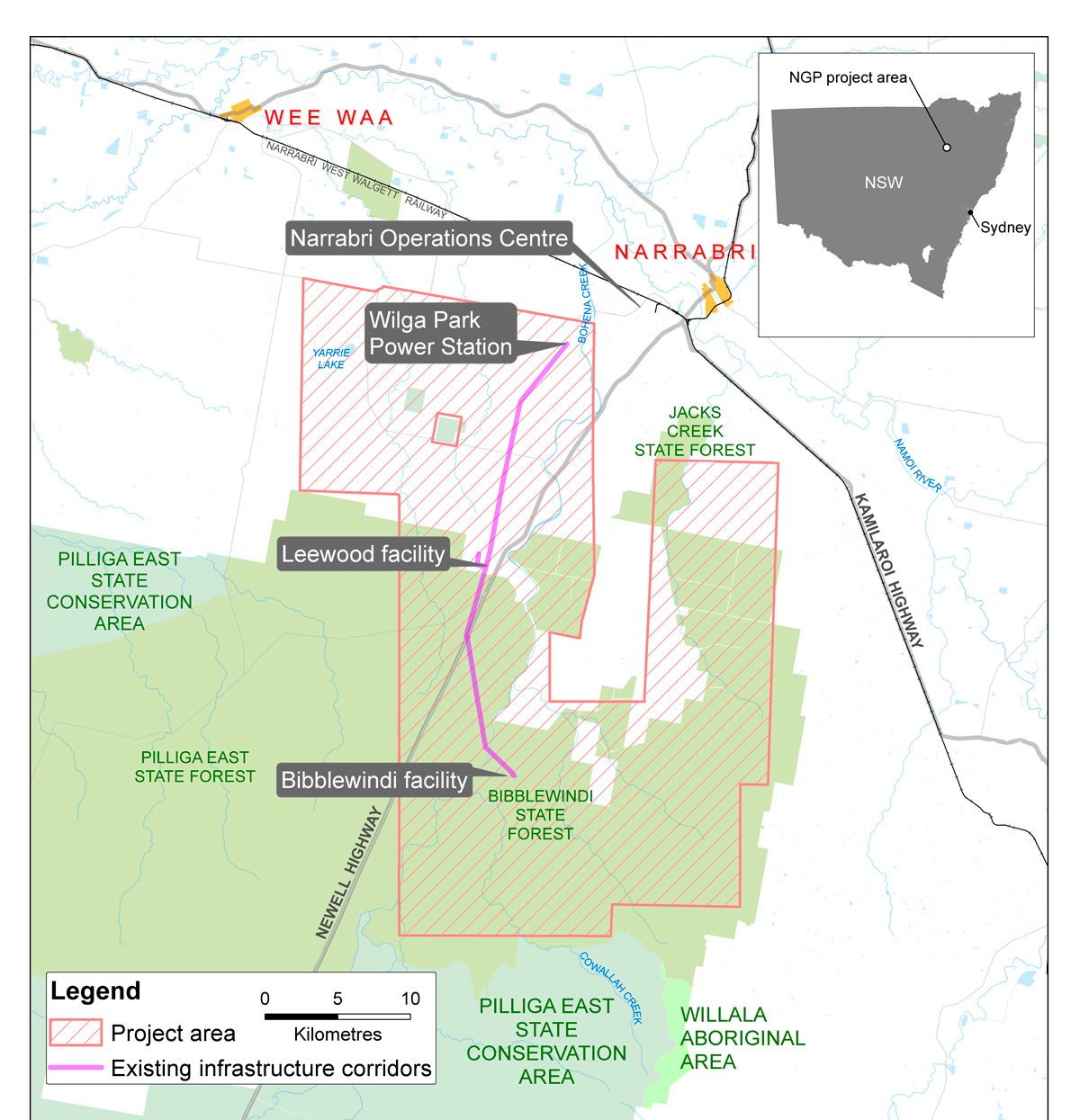
Santos’ operations will be located within a 1,000-hectare (ha) footprint of the total 95,000ha project area, in and around a section of the Pilliga which has been designated by the NSW Government for timber harvesting, extractive industries (like natural gas extraction) and other commercial activities. The remainder will be on private land, subject to agreement with the landholders. We already have some agreements in place with landholders in close proximity to the Pilliga Forest. The project area does not include areas of National Park or Natural Reserves or areas identified as biophysical strategic agricultural land (BSAL).
Explore further: Map of the Narrabri Gas Project area
How will the natural gas get from the Pilliga to the rest of NSW?
Narrabri gas would be made available to the east coast domestic market via the proposed Hunter Gas Pipeline, acquired by Santos in 2022. Santos proposes to construct the Narrabri Lateral Pipeline in order to connect our Narrabri operations to the Hunter Gas Pipeline, which would tie into the existing NSW gas transmission network near Newcastle. More information about the Hunter Gas and Narrabri Lateral Pipelines can be found at https://huntergaspipeline.com.au/
How will the north-west region benefit from the Narrabri Gas Project?
We want the local communities where we live and work to benefit from our ongoing presence. In addition to creating local jobs, supply opportunities and providing land-use payments to landholders, Santos will establish a Regional Community Benefit Fund when the project reaches production. We estimate the Fund will provide up to $120 million over the life of the Project to support important community initiatives and infrastructure upgrades in the Narrabri region. The project is also expected to provide around $1.2 billion in royalties to the state of NSW that can be reinvested in key government services such as health, education and roads.
What employment opportunities will be associated with the Narrabri Gas Project?
We expect there will be around 1,300 jobs during construction and up to 200 ongoing positions. There will also be jobs created with local contractors and suppliers working on the Project as well as indirect jobs in various sectors that provide local services and cater for workers and their families.
Will you be using local suppliers and contractors?
We want to ensure local businesses are given every opportunity to be involved with our work. Santos already uses local contractors and suppliers whenever possible and this practice will continue. We work with local suppliers and contractors to assist them to put in place appropriate systems, policies and processes so they are compliant with our Contractor and Supplier Management Standards.
Find out more: Business Opportunities
Natural Gas
What is natural gas?
Natural gas is a fuel that is made up mainly of methane. It is found in several different types of rocks including sandstone and in coal seams like those found in the Narrabri Project area.
Natural gas is used to generate electricity in our homes and industries and is used for cooking and heating. It is also an essential fuel in various industrial processes including making bricks, glass, steel, plastics, paint, fabrics, fertilisers and many other products.
What is coal seam gas?
How is natural gas extracted?
Natural gas and water are held in the coal seam by pressure. To extract the natural gas, a well is drilled into the coal seam. The water is extracted, releasing the pressure within the coal seam, allowing the gas to flow up through the well to the surface.
Explore further: Drilling with Care fact sheet
Landholders
Will you be working near my property?
Landholders within our proposed Project area have been contacted by our team and receive regular updates from us.
We will only drill on private land if the landholder is happy to host our operations.
How will you minimise the impact on agricultural land?
If a landholder agrees to work with Santos, a land access agreement will be negotiated and compensation arrangements put in place.
A Farm Management Plan will also be developed to coordinate activities and minimise impact on landholder’s business productivity and lifestyle. Natural gas extraction can co-exist with other land uses such as agriculture because of the relatively small amount of land used. There is also some flexibility with where activities can be situated on a property; allowing our operations to work in harmony with the landholder’s agricultural business.
What are the financial benefits for landholders who work with Santos?
Landholders involved in our exploration program will be compensated for the value of the land being utilised by our operations and will receive an annual fee for this service. When the Narrabri Gas Project reaches production, landholders will share in a compensation pool, with income proportionate to the amount of their land being utilised and the performance of the field.
What if landholders don’t want Santos to go on their land?
We have been very clear that we will only drill on private land with the agreement of the landholder. We have signed the Agreed Principles of Land Access with NSW Farmers, Cotton Australia, the NSW Irrigators Council, the Country Women’s Association (NSW), Dairy Connect and fellow energy company AGL, which reinforces this commitment.
How have you been working with local Aboriginal people?
The Gomeroi People’s Native Title claim covers the parts of the Pilliga in which we are seeking to work. We meet regularly with the Gomeroi registered claimants and are working towards an agreement with them. We meet regularly with the Local Area Land Councils included in the project area and Aboriginal parties have been involved in the cultural heritage work needed for the Project’s Environmental Impact Statement (EIS). We will work with the Aboriginal community to put initiatives in place that will allow them to benefit from our work in the Narrabri area.
How do you rehabilitate sites?
About one hectare of cleared area is required when drilling a well, so that the necessary equipment can be put in place. When drilling is complete, we begin to reduce the cleared area around each well and rehabilitate surplus access tracks.
When a well is no longer producing gas it is decommissioned. The surface wellhead and equipment is removed and the well is completely sealed with pressure-tested cement plugs from top to bottom. The cement used is formulated to be stronger than the layers of rock it passes through and is designed not to degrade over time to ensure underground formations remain isolated. The site is then completely rehabilitated and the land can be returned to its previous use.
Over the life of the Project, we will progressively rehabilitate areas as wells come on and off line, to minimise the total area cleared at any one time.
Water
Why is water produced when gas is extracted?
Natural gas and water are held in the coal seams by pressure. To extract natural gas from coal seams, water is extracted from the seam. This releases the pressure allowing the natural gas to flow up through the well to the surface. Water extracted will be treated to a very high standard so it can be beneficially re-used for activities such as irrigation. We anticipate approximately 80% of the water can be reused.
Is the water you extract taken from the Great Artesian Basin?
No. Water we extract is different to the water accessed by agriculture and community bores and is not taken from the Great Artesian Basin. In the Narrabri area, it comes from coal seams located 500 to 1,200 metres below the surface.
Is the water that you extract suitable for agriculture or community use?
The water we extract in the Narrabri area is about half as salty as seawater meaning it is too salty for stock use or irrigation unless treated. Santos plans to treat extracted water to a very high standard, so it can be beneficially re-used for activities like irrigation.
What rules and regulations apply to the water extracted during your work?
Before we extract any water, we must have a Water Access Licence in place; just like other users. This water must be obtained, and paid for, from the market. Our water extraction is also assessed against the Government’s Aquifer Interference Policy.
What happens to the water you extract?
Currently, water from our exploration wells is transferred from the field via an underground flow-line to double-lined storage ponds at our Leewood facility, adjacent to the Pilliga.
The water is desalinated at a reverse osmosis facility at the site and, once it meets Australian irrigation standards, is used to irrigate a lucerne crop planted on the Leewood property.
Santos estimates about 80% of the water extracted as part of the Project will be able to be reused following treatment for irrigation, dust suppression and construction activities.
What will you do with the salt that remains after water treatment?
The salt waste product is classified as general solid waste under the NSW Waste Classification Guidelines.
Santos will manage the salt in a safe and sustainable manner and in accordance with all regulatory requirements.
Santos will seek regulatory approval to sell the remaining salt commercially or dispose of the salt to a licensed landfill if no buyer can be found.
Will my bore be impacted by your work?
We expect there to be no impact to local bores due to the depths at which we operate. As standard practice, we offer to monitor all bores of landholders within a 2km radius of our operations giving landholders added confidence that our work does not affect their water supply.
Aquifer protection
What are gas wells made of? How strong are they?
Wells are made from layers of steel and cement which isolate the coal seams we target from the geologic layers and aquifers above.
The steel casing which lines the wells is specially designed to withstand operational pressures during drilling operations, testing and production and to resist corrosive subsurface conditions. The steel casing is also protected by specially formulated cement designed to be as strong as the rock into which the well is drilled.
Click here: Drilling with Care fact sheet
To what standard are the gas wells constructed?
Our wells are drilled to the highest industry standards to ensure there are no integrity issues and layers of steel casing and cement seal off the well from shallow aquifers as we drill down to the coal seams.
The NSW Well integrity Code of Practice requires Santos to keep and maintain extensive records of each well’s construction and its on-going monitoring and maintenance. These records must be lodged with, and reviewed by, the petroleum regulator each year.
How do you protect the aquifers when drilling?
The coal seams we are targeting in the Narrabri area are between 500 to 1,200m below the surface. They are separated from the shallow aquifers used by farmers and the community by hundreds of metres. When we drill through the aquifers they are isolated behind single or double layers of steel and pressure tested cement, which prevents cross-contamination.
Click here: Protecting Local Aquifers fact sheet
Will your work impact the Great Artesian Basin?
Shallow aquifers, (including the Pilliga sandstone which is an extension of the Great Artesian Basin), generally lie between 5 – 300 metres below the surface in the Project area. In Narrabri, the coal seams we are targeting typically lie between 500 – 1,200 metres underground.
There are layers of solid rock between the Pilliga sandstone and the coal seams. These rock layers are known as aquitards and act as natural barriers to the water travelling up and down.
This geology, along with existing information from previous research on the area in which we are working, gives us confidence we will not impact local water resources.
We have established a network of shallow and deep aquifer monitoring bores around our project area. Data from these wells will give the community added confidence our work is not impacting aquifers. Water quality and water level data from these wells can be publicly accessed via Santos’ water portal.
Explore further: Santos Water Portal
The Narrabri Gas Project and the GAB
Are there any independent studies that demonstrate water quality and quantity impacts of your work?
The Namoi Catchment Water Study, carried out by independent experts and commissioned by the Government, showed no harmful impacts to groundwater from natural gas developments on a much larger scale than we are proposing with the Narrabri Gas Project.
The study predicted there would be a drawdown of less than 0.5m over 90 years – which is within the range of existing seasonal variations.
Click here: Final Report Namoi Catchment Water Study
What is fracking and will it be used in the Narrabri Gas Project?
Hydraulic fracture stimulation (commonly referred to as “fracking”) is a technique used to improve the flow of natural gas from a well. Water, sand and a small amount of chemicals are pumped into a well and down into the coal seam at high pressure to open up fractures in the coal. The sand remains in the fractures to hold them open, allowing more gas to flow, and the fluid is pumped back out of the well.
While fracking has been safely used as a drilling technique throughout Australia for over 40 years, Santos will not use this technique as part of the Narrabri Gas Project. Due to the geology of the coals in the Project area It is not necessary for us to frack as part of the Narrabri Gas Project, and we have no approval to do so.
Protecting the Pilliga
Will the Narrabri Gas Project impact the Pilliga?
The Pilliga covers an area of 500,000 hectares. Santos’ operations will be located on about 1,000ha of land within the 95,000 hectare project area, representing about 0.2% of the 500,000ha Pilliga.
The area of the Pilliga in which we will be operating has been designated by the Government as suitable for “forestry, recreation and mineral extraction”.
This part of the Pilliga has a long history as a working forest, and vegetation has been disturbed by farming, fires and logging. Throughout the 500,000 hectares of the Pilliga there are already over 5,000km of roads, access tracks and easements and we will use these existing tracks where possible to minimise any clearing.
The project area does not include areas of National Park or Natural Reserves.
Click here: Working in the Pilliga fact sheet
View: Map of Project Area
How much do you know about the ecology of the Pilliga?
Santos has access to an extensive range of data with more than 13,000 hours of on-ground ecological surveys carried out over several years in conjunction with environmental experts. This has been used to produce detailed mapping of the Project area to identify flora and fauna habitats and sensitive ecological areas.
Regulations
What regulations are in place for the industry?
The natural gas industry in NSW is one of the most highly regulated industries in Australia. Over the past few years, both the NSW and Commonwealth Governments have put in place a range of measures designed to build on the already extensive regulation. A number of State and Commonwealth agencies oversee the industry, as well as the Commonwealth Independent Expert Scientific Committee.
Other questions
How do you keep the local community informed about your work?
Santos is committed to ensuring the local community is kept informed about our projects as they progress. All regulatory approval documents are available on our website, and we provide regular activity updates via the local newspaper, on our website, and via the monthly newsletter.
Santos has a shopfront in the main street of Narrabri to provide the community ease of access to our team and information about our work.
We hold regular information sessions and give presentations on our work to interested community and business groups.
We also hold regular site tours to our field areas so people can have a firsthand look at our operations.
Interested in the next site tour?
Community site tours can be facilitated upon request.
If you would like to find out more, or register your interest please email energy.NSW@santos.com or call our Narrabri shopfront team on 02 6792 9035.